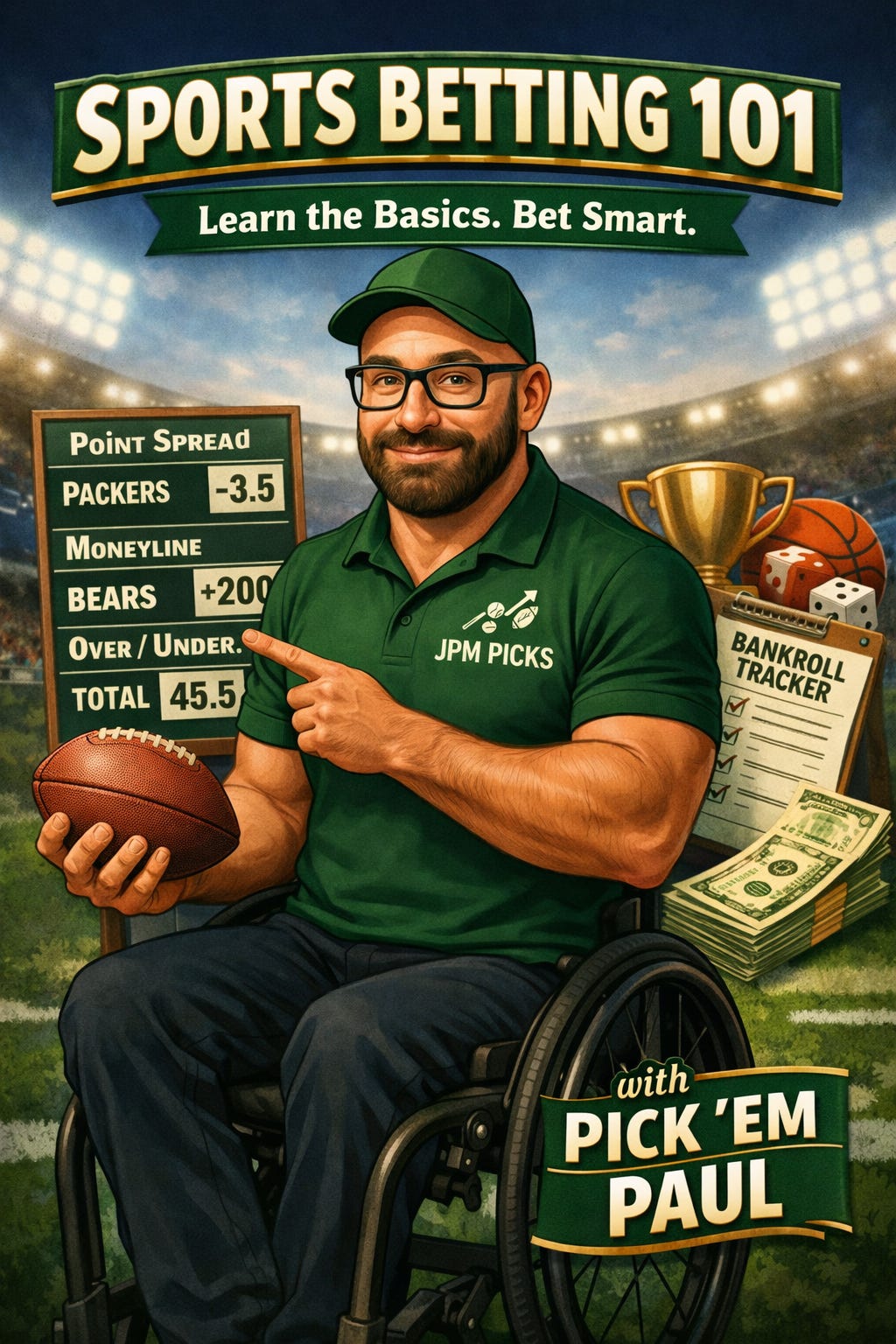
Sports betting is one of the fastest ways to make a random Tuesday night game feel like a playoff atmosphere… but it’s also one of the fastest ways to get humbled if you jump in without a basic playbook.
This guide is built for beginners. By the end, you’ll know what the most common bet types mean, how odds work, how to avoid the classic mistakes, and how to pick where you should place your bets.
Quick note: Everything on JPM Picks is Just Paper Money (that means for entertainment only). I am not offering financial advice or gambling advice. Always bet responsibly, keep it fun, and never risk money you can’t afford to lose.
What you’ll walk away with:
The only betting terms you need to start
How to read odds (-110, +250, etc.) without getting lost
The 4–5 bet types you’ll see everywhere
How to choose a sportsbook (and what to avoid)
A beginner game plan that keeps you alive long enough to learn
The 60-Second Betting Primer
Before we talk spreads, parlays, and all the shiny stuff, here’s the simple truth:
Sports betting is just pricing probability. You’re not just picking winners, you’re picking numbers (odds, spreads, totals) and deciding whether they’re worth the risk.
Now let’s make sure you’re betting in the right place, the right way, and with the right expectations.
First question: Can you even place a bet where you live—and what counts as “betting” now that prediction markets exist?
Legality Basics: Where You Can Bet (and What “Counts”)
Sports betting rules vary by state and country, and they can change. So, the goal here isn’t a law lecture (I’m no lawyer, I’m just a guy on the internet.) It’s a common-sense way to make sure you’re betting legally, safely, and on the right kind of platform.
Here’s a quick framework:
Know your local rules (because what’s allowed in one place may not be allowed in another)
Use legitimate platforms that verify identity and location
Understand the difference between sportsbooks and prediction markets
How to verify in two minutes (without guessing):
Check your state’s official gaming/regulatory site (or official state resources).
Confirm the platform’s availability list and terms (most have a “Where we operate” page).
Remember: many legal platforms use geolocation + identity verification. You may be able to download an app, but you can’t place a wager unless the service is available and you’re eligible where you are.
One more note on “what counts”:
A sportsbook is traditional sports wagering (spreads, moneylines, totals, props).
A prediction market is typically framed as buying/selling outcome contracts. Some people treat these like sports betting alternatives, but availability and rules can vary, so always check eligibility and local guidelines before using them.

Choosing Where to Bet: Sportsbooks vs. Prediction Markets
There are two buckets beginners run into today:
Sportsbooks (traditional): You place a wager using odds set by the book (spread, moneyline, totals, props). If you’re in a legal market, licensed sportsbooks will typically use identity + location checks before allowing you to bet.
Prediction markets (newer): You’re usually buying/selling outcome contracts rather than placing a traditional sportsbook bet. Some people treat these as an alternative when sportsbooks aren’t available, but availability and rules can vary, and the experience can feel more like trading than betting.
Keep it simple: whichever route you use, prioritize transparency, safety, and clear rules, especially around payouts, fees, and withdrawals.
Now that you know where bets happen, let’s translate what you’re seeing on the screen starting with the three core bet types you’ll see everywhere.
The Big Three Bet Types You’ll See Everywhere
If you understand these, you can understand about 80% of sports betting:
Point Spread
Moneyline
Totals (Over/Under)
You’ll see other stuff (props, parlays, futures), but these three are the foundation and they show up on almost every game you’ll ever bet.
Below are quick examples of what each one looks like on a sportsbook screen.
The Point Spread

The above Example means to win your bet on the Packers; they must win by 8 or more points. If you bet on the Bears; to win your bet, they can lose by 7 or less points (or win the game outright).
The Moneyline

The Money line is picking the winner of the game with different odds depending on who the sportsbook deems to be the favorite (explained in the next section).
The Total

Betting the total is one of the easiest and basic bets (and one of my favorites). In this example if you bet Over 45.5, you think more that 45 points will be scored in the game. If you bet under you think less than 45 points will be scored in the game.
Now that you know what you’re betting on, the next step is to understand the price of the bet (those numbers like -110, +250 and -300).
Odds in Plain English (American + Fractional)
Odds are just the price of a bet.
Negative odds (like -110): how much you need to risk to win $100
Positive odds (like +250): how much you win if you risk $100
Quick example: at -110, you risk $11 to win $10 (or $110 to win $100). At +250, you risk $10 to win $25 (plus your original bet back).
Once you understand that, you can calculate payouts for any wager size—$5, $10, $50 without guessing.
Now we get to the part that determines whether you survive long-term: not your picks, your bankroll rules.

Bankroll Rules for Beginners (The Part Nobody Wants to Read)
You can be “right” a lot and still go broke if your bet sizing is reckless. Bankroll management isn’t flashy, but it’s the difference between learning the game and donating to it.
Why you need to win more than 50% (the vig)
Most spreads and totals are priced around -110 on both sides. That means you’re risking $11 to win $10 (or $110 to win $100). That extra “fee” is the sportsbook’s edge. This is called the vig (or “juice.” It’s not as tasty as orange juice, trust me).
Because of the vig, you don’t break even by winning half your bets. At -110, you generally need to win about 52.4% just to break even over time.
The non-negotiables
Set a betting budget. This is entertainment money. Once it’s gone, you’re done until the next time you choose to reload.
Use a simple bet sizing rule. Beginners should keep it boring: flat bets (same amount each time) or a small percentage of bankroll (no more than 5% on one bet).
Track everything. Date, bet type, odds, stake, result. If you don’t track it, you’re guessing.
Never chase losses. Chasing turns one bad night into a bankroll-ending week. (To be transparent, I am terrible at this)
With bankroll rules in place, the rest becomes simple. Make small, informed bets, and let your results (not your emotions) guide your next move.
Research Without Overthinking It
You don’t need to build a supercomputer with 1000s of data models to be a successful sports bettor. You just need a repeatable process so you’re not betting off vibes.
Start with this checklist:
Injuries + availability: who’s in, who’s out, who’s limited
Line movement: did the number move—and why?
Matchups: style vs style (strength vs weakness)
Situational spots: travel, rest, back-to-backs, motivation
Avoid headline bias: don’t overreact to the last game you watched
The goal isn’t perfection; it’s consistency. If you do the same basic homework every time, your picks get sharper and your mistakes get easier to spot.
Before we wrap, there’s one last beginner step that matters more than people think: choosing the right sportsbook (or platform) and not getting trapped by shiny promos and bad withdrawal rules.
Sportsbook Checklist (Promos, Payouts, Trust, and User Experience)
This is your “don’t get burned” list. Before you deposit money anywhere, run through this:
Reputation + licensing: Stick with well-known, regulated operators where you live.
Withdrawals + deposit methods: Test a small deposit first, and make sure withdrawals are straightforward (and not slow or confusing).
Promo fine print: The headline bonus is never the whole story. Read the wagering requirements and restrictions.
Odds quality: Even small differences matter over time. If you bet a lot, better pricing adds up.
Customer service: If something goes wrong, you want fast support (live chat is a good sign).
Mobile usability: If the app is clunky, you’ll make mistakes, especially live or rushed bets.
Quick tip: Before committing, place one small bet and do a small withdrawal later. That “test run” tells you more than any ad.
At this point you know enough to place your first bet the right way. Let’s finish with a simple beginner game plan and a couple tools to stay organized.
Your Beginner Game Plan (Do This, Not That)
If you do nothing else, do this for your first 30 days. The goal isn’t to “get hot.” The goal is to build habits that keep you in the game.
Start with straight bets only. No parlays, no gimmicks, just one bet, one outcome.
Keep stakes small. You’re buying reps and learning, not trying to force income.
Track every wager. Date, bet, odds, stake, result. Patterns show up fast when you write them down.
Focus on learning, not “making it back.” Chasing turns one loss into five bad decisions.
Earn complexity. Consistency first. Fancy stuff later.
If you want the next level: live betting, hedging, arbitrage, parlays/props/teasers, and futures (including fractional odds) deserve their own post, so beginners don’t skip the fundamentals.
If you found this article helpful, consider subscribing so you don’t miss Sports Betting 201, and follow along for more JPM Picks content.