Let’s be honest: “stock options” sounds like one of those things you need a finance degree (and three monitors) to understand.
You don’t. (In fact, I only have one 32” monitor.)
Most beginners get tripped up because they start in the wrong place—chasing big wins, YOLO trades, and screenshot-worthy lottery tickets.
This is JPM Picks, not Wall Street Bets.
We’re keeping it simple: calls, puts, and how premium works. For now, we’re building the foundation the smart way: simple, repeatable moves that can help you collect premium and improve your entry/exit prices on stocks you’d be happy to own.
Here’s what you’ll learn in this post:
What options are in plain English (no jargon soup)
The difference between a call and a put
How options can be used for income, risk management, and better stock prices
Two beginner-friendly strategies I consider the “bread and butter” for most normal humans:
Covered calls (getting paid to potentially sell shares you already own)
Cash-secured puts (getting paid while waiting to buy a stock at a price you want)
If you’ve ever said, “I like this stock, I just wish I could buy it cheaper” or “I wouldn’t mind selling here if I could get paid extra,” you’re in the right place.
So, what is a stock option really, and what are you agreeing to when you click “Sell to Open”? Let’s break it down.
The 60-Second Options Primer
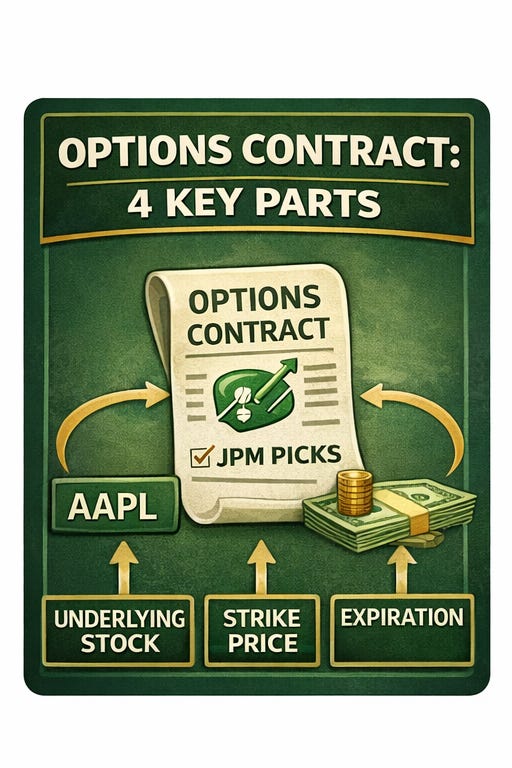
An option is just a contract, and every contract has the same four pieces:
The underlying stock (AAPL, NFLX, etc.)
Strike price: the agreed price
Expiration: the deadline
Premium: the price of the contract (what gets paid today)
Here’s the part most beginners miss: options are “rights” or “obligations,” depending on whether you buy or sell them.
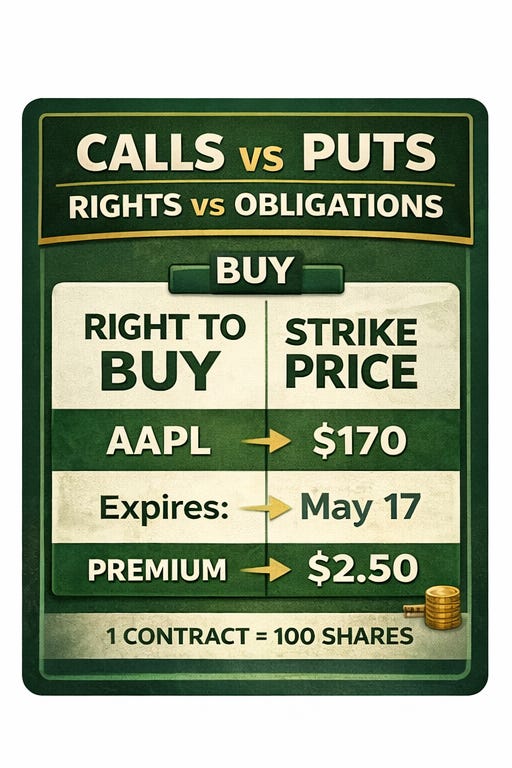
First, remember this: 1 option contract = 100 shares.
So a premium quote of $1.25 usually means $125 (because $1.25 × 100).
Now the big split:
Buying options = you pay premium for rights (you can walk away).
Selling options = you collect premium for obligations (you might have to act).
And if your trading app looks like it’s speaking another language, here’s the translation:
Buy to Open = start a bought option
Sell to Open = start a sold option
Buy to Close = end a sold option
Sell to Close = end a bought option
If you remember nothing else from this section, remember this:
Premium hits your account today. The obligation only becomes real if you’re assigned.
Next, we’ll zoom in on calls vs puts, without the jargon headache.
Calls and Puts (In Plain English)
Options get complicated fast. But the foundation is always the same: calls and puts. Most of what I do as an options trader starts with puts, then moves to calls.
Put (buy-at-this-price contract)
A put is the ‘buy at this price’ contract.
If you sell a put, you’re taking on the obligation to buy shares at the strike price if you get assigned.
If you buy a put, you’re paying for the right to sell shares at the strike price before expiration.
Think: Put = someone can “put” shares onto you.
Call (sell-at-this-price contract)
A call is the ‘sell at this price’ contract.
If you sell a call, you’re taking on the obligation to sell shares at the strike price if you get assigned. (This is what I do most when it comes to calls.)
If you buy a call, you’re paying for the right to buy shares at the strike price before expiration.
Think: Call = someone can “call” the shares away from you.
That’s the whole game: puts are about buying (or agreeing to buy), and calls are about selling (or agreeing to sell). Whether you buy or sell determines if you have rights or obligations.
Buying an option is like taking a shot. Selling an option is like setting the line; you’re getting paid because you’re taking the other side.
Next up: we’ll start with the simplest income play for stock owners, covered calls.
Covered Calls (Getting Paid to Set a Sell Price)
A covered call is the simplest “premium income” play there is, as long as you already own the stock.
Here’s the idea:
You own 100 shares of a stock you like. Then you sell a call against those shares. (“Sell to Open” like we talked about in the previous section.)
When you sell that call, you get paid a premium upfront. In exchange, you’re making a deal:
“If this stock gets above this price (the strike) by this date (expiration), I’ll sell my shares at that strike price.”
That’s why it’s called covered — your obligation to sell the shares is “covered” because you already own them.
Why people like covered calls
Covered calls can help you:
Collect Premium while you hold a stock
Lower your cost basis (the premium offsets your share cost)
Set a disciplined exit price instead of getting emotional
If you’re the type who says, “I wouldn’t mind selling this at $55…”
A covered call is basically you saying that — and getting paid for it.
The two outcomes (and both can be fine)
Outcome #1: The stock stays below your strike.
Your call expires worthless. You keep your shares, and you keep the premium.
Outcome #2: The stock goes above your strike.
Your shares can get “called away.” You sell at the strike price, and you keep the premium.
That’s the tradeoff: you’re getting paid today, but you’re capping your upside.
If the stock absolutely rips higher, you don’t fully participate past the strike.
Covered call risk (don’t skip this)
A covered call does not protect you from a big drop.
If your stock falls hard, the premium helps a little, but you still own the shares.
(That’s why stock selection matters, a lot.)
A quick example (simple numbers)
Say you own 100 shares of a stock at $50.
You sell a $55 call expiring in 30 days and collect $1.00 in premium.
That’s $100 paid to you today.
If the stock stays under $55 → you keep the $100 and your shares.
If the stock goes above $55 → you sell at $55, and you keep the $100.
Either way, you got paid to set a sell price.
Pick ’Em Paul rule: Only sell covered calls on stocks you’d be okay holding… and okay selling.
Pick ’Em Paul rule #2: I prefer selling covered calls on green days. When the stock is up, you’re usually selling that call at a better price (and the premium is often a little richer).
Cash-Secured Puts (Getting Paid to Buy at Your Price)
If covered calls are “getting paid to sell,” cash-secured puts are the opposite:
You’re getting paid to buy.
A cash-secured put is when you sell a put on a stock you wouldn’t mind owning, and you keep enough cash in your account to pay for the shares if you get assigned.
That “cash-secured” part matters because:
1 contract = 100 shares
So, if you sell a put (‘Sell to Open’) with a $45 strike, you’re agreeing you might buy 100 shares at $45
That means you need $4,500 set aside (per contract)
Why people like cash-secured puts
Cash-secured puts can help you:
Generate premium income while you wait
Set a disciplined buy price instead of chasing the stock
Potentially enter at a discount (because the premium reduces your effective cost)
If you’ve ever said, “I’d buy this stock… just not at today’s price,” this is your move.
The two outcomes (and both can be fine)
Outcome #1: The stock stays above your strike.
Your put expires worthless. You keep the premium, and you never buy the shares.
Outcome #2: The stock drops below your strike.
You can get assigned, meaning you buy 100 shares at the strike price.
And here’s the key:
Your effective buy price is usually lower than the strike because you keep the premium.
Example: if you sold the $45 put for $1.00, you collected $100.
If assigned, it’s like buying at $44 (strike $45 minus $1 premium).
The risk (and it’s a real risk)
The risk of cash secured puts is simple:
If the stock falls hard, you still may have to buy at the strike (unless you close the position early).
So don’t sell puts on junk you don’t want. You’re not “just collecting premium”, you’re agreeing to potentially become a shareholder.
Premium is not free money. It’s payment for taking on obligation. And if you sell enough cash-secured puts, eventually you’ll catch a trade that moves against you. That’s why stock selection and strike discipline matter.
A quick example (simple numbers)
Let’s say a stock is trading at $50, but you’d rather own it at $45.
You sell a $45 put expiring in 30 days and collect $1.25 in premium.
That’s $125 paid to you today.
If the stock stays above $45 → you keep the $125 and move on.
If the stock drops below $45 → you may buy 100 shares at $45, and you keep the $125.
Either way, you got paid to name your price.
Pick ’Em Paul rule #1: Only sell cash-secured puts on stocks you’d be comfortable owning for the next 6–12 months.
Pick ’Em Paul rule #2: If I’m planning to sell a cash-secured put anyway, I’d rather do it after a red day (or a small dip) rather than after a big green run because put premiums are often better when fear picks up and prices pull back.
Next up: now that you understand covered calls and cash-secured puts, we can connect the dots and talk about how people combine them into a repeatable approach, called the wheel strategy.
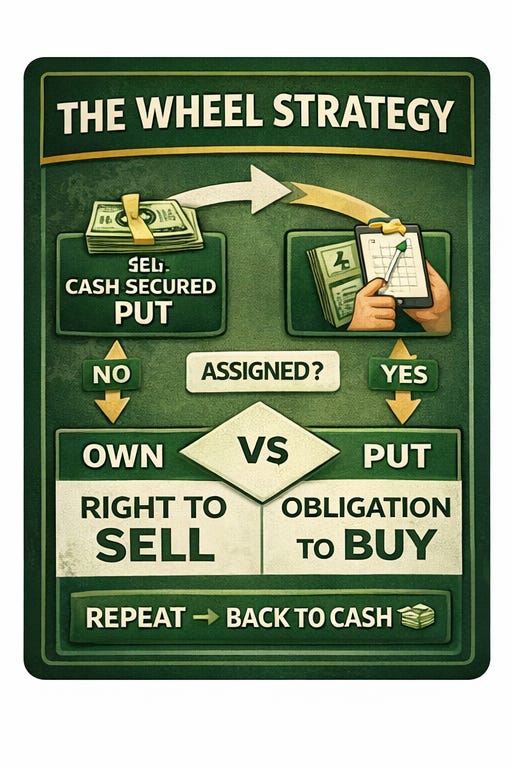
The Wheel Strategy (Connecting the Dots)
Now that you understand covered calls and cash-secured puts, you’re ready for my favorite option strategy, the wheel. They don’t call Pick ’Em Paul the rolling quad for nothing. (okay, nobody calls me that… yet).
The wheel strategy is just a repeatable way to rotate between those two plays.
No magic. No secret sauce.
It’s basically this:
Sell a cash-secured put on a stock you’d be happy to own
If you get assigned, you now own 100 shares
Sell covered calls on those shares to collect premium
If your shares get called away, you’re back to cash
Repeat back to cash-secured puts
That’s the “wheel.”
Starting point matters
There are two ways people begin:
Starting with cash (no shares):
You start by selling cash-secured puts until you either get assigned or decide to stop.Starting with shares already owned:
You can skip straight to covered calls on what you already hold.
The wheel in one sentence
You’re either:
Getting paid while waiting to buy, or
Getting paid while waiting to sell
The three “rules” that keep it sane
Rule #1: Pick the right stocks.
If you wouldn’t feel okay owning it for months, don’t wheel it. You’re not just trading a ticker; you’re signing up to potentially own 100 shares.
Rule #2: Your strike prices are your buy/sell decisions.
A put strike is basically your “I’d buy it here” line.
A call strike is basically your “I’m okay selling it here” line.
If you don’t like those prices, don’t place the trade.
Rule #3: Don’t confuse premium with performance.
Premium helps. It can lower your cost basis and add income. But it doesn’t erase the fact that stocks can drop and drops hurt. And stock drops do happen!
Where people go wrong
Selling puts on a stock they don’t understand just because the premium is higher.
Choosing strikes too close to the current price because they want “more premium”
Acting shocked when assignment happens (assignment is not a glitch, it’s why you’re getting paid that premium)
If you treat assignment like a disaster, this strategy might not be for you.
If you treat assignment like the plan, it makes a lot more sense.
Next up: how to pick strikes, expirations, and stocks so you’re not just spinning the wheel, you’re doing it with intention.
Picking Your Strike + Expiration (So You’re Not Just Clicking Buttons)
This is where beginners either run the wheel calmly… or turn it into chaos.
Because once you understand what a put or call is, the next question is:
“Okay… which strike and which expiration do I pick?”
Here’s the Pick ’Em Paul way to think about it.
Step 1: Start with the price you’d actually accept
Forget the option chain for a second.
Cash-secured put: At what price would I be genuinely happy buying 100 shares?
Covered call: At what price would I be okay selling my 100 shares?
If you don’t like the price, don’t place the trade. Premium isn’t a valid reason to hate your own strike.
Step 2: Give yourself enough room
Newer traders love picking strikes right next to the current stock price because it pays more.
That also increases the chance you get assigned (puts) or called away (calls) fast, sometimes before you’ve even gotten comfortable.
A simple beginner-friendly approach:
Pick strikes that are out-of-the-money (not right on top of the stock price)
Let the stock breathe a little
You’re trying to run a repeatable process, not win one spin.
Step 3: Keep expirations simple (at first)
Short expirations move fast and can get emotional.
For most beginners, a clean starting range is:
~30–45 days out (enough time to work, not so long it drags forever)
Then you can close early if you’ve already captured most of the premium.
Step 4: Premium is tied to movement
You’ll notice premiums rise when the stock is moving more (or the market is stressed). That’s normal, just remember the higher premium usually means higher “this thing could move against me” risk.
Next up: the checklist I use before I sell any put or call — so my trades are planned, not impulsive.
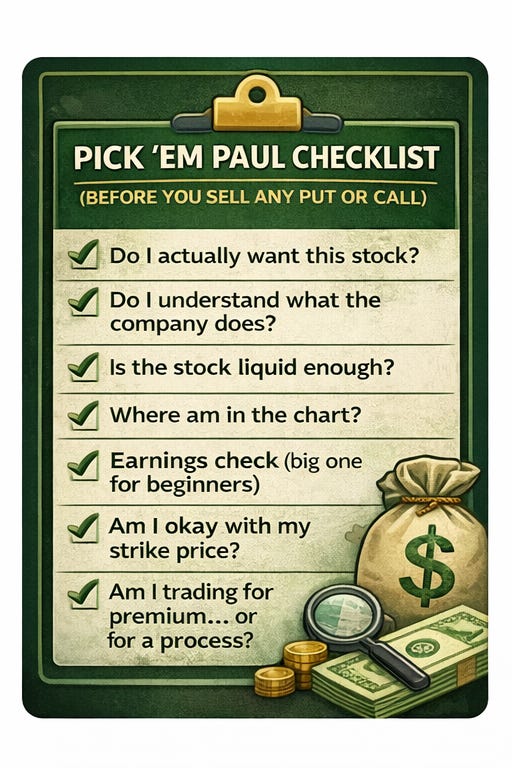
The Pick ’Em Paul Checklist (Before You Sell Any Put or Call)
This is the part that keeps you out of trouble.
Because selling options is simple… until you do it on the wrong stock, at the wrong time, for the wrong reason.
Before I sell a cash-secured put or a covered call, I run this quick checklist:
✅ 1) Do I actually want this stock?
If assignment happened today, would I be okay owning 100 shares?
If the answer is “meh” or “no,” I’m out.
✅ 2) Do I understand what the company does?
If I can’t explain the business in one sentence, I probably shouldn’t be trading options on it.
✅ 3) Is the stock liquid enough?
Tight bid/ask spreads on the option chain
Decent volume/open interest
If it trades like a ghost town, you’ll pay for it in bad fills.
✅ 4) Where am I in the chart?
Not predicting the future — just avoiding bad spots.
Selling puts after a big run-up? Risky.
Selling calls after a big dump? Also risky.
I’d rather sell into normal moves, not extremes.
✅ 5) Earnings check (big one for beginners)
If earnings are coming up during the life of my option, I usually pass as a beginner.
Why? Because earnings can gap a stock right through your strike overnight.
Premium is often higher going into earnings… and that’s not a gift. That’s risk being priced in.
✅ 6) Am I okay with my strike price?
This is non-negotiable.
Put strike = “I’m willing to buy here.”
Call strike = “I’m willing to sell here.”
If I’m not comfortable with that price, I don’t place the trade.
✅ 7) Do I have a plan if it moves against me?
Before I click anything, I know what I’ll do if:
The stock drops and my put goes in-the-money
The stock runs and my covered call gets threatened
Maybe I accept assignment. Maybe I roll. Maybe I close early.
But I’m not improvising with real money.
✅ 8) Am I trading for premium… or for a process?
The goal isn’t to squeeze every last dollar out of one trade.
The goal is a repeatable approach you can run without panicking.
If I’m forcing a trade because I’m bored, chasing losses, or trying to “make something happen”… I walk away.
Next up: a beginner game plan, the easiest way to start so you don’t blow up your account with your first trade.
Beginner Game Plan + Closing (Your First Real Steps)
If you take nothing else from this post, take this:
Start small, stay boring, and build reps.
Here’s a simple beginner game plan that doesn’t require a finance degree, or 12 open tabs on those 3 monitors.
Step 1: Pick 1–2 stocks you’d be happy owning
Not “hot” stocks. Not random tickers you saw on X (And certainly not because it’s a stock you saw on Pick ‘Em Paul’s substack). Pick names you actually understand and wouldn’t mind holding for a while if you get assigned.
Step 2: Paper trade (or go tiny) for 2–4 cycles
Your first goal isn’t to “make money.” It’s to learn the mechanics:
What it feels like when price moves against you
How premiums change
What assignment looks like in your account
If you can’t paper trade, fine. Just keep size small enough that you can sleep.
Step 3: Start with cash-secured puts
Sell one cash-secured put at a strike you’d truly buy an underlying stock at.
If it expires worthless, great — you got paid to wait.
If you get assigned, that’s not failure — that’s the plan.
Step 4: If assigned, move to covered calls
Once you own 100 shares, sell a covered call at a strike you’d be okay selling at.
Repeat until your shares get called away… or until you decide you want to keep holding.
Step 5: Keep a simple tracking note
Nothing fancy. Just track:
Ticker
Strike / expiration
Premium collected
What happened (expired, assigned, called away)
Most people don’t have a strategy problem — they have a “no process” problem.
Options don’t have to be complicated. But they do require discipline.
This is JPM Picks — we’re here for repeatable plays, not lottery tickets.
If you’d like, let me know:
what broker you use, and
one or two stocks you’re considering for your first covered call or cash-secured put
…and I’ll help you pressure-test the choice and build your first setup.