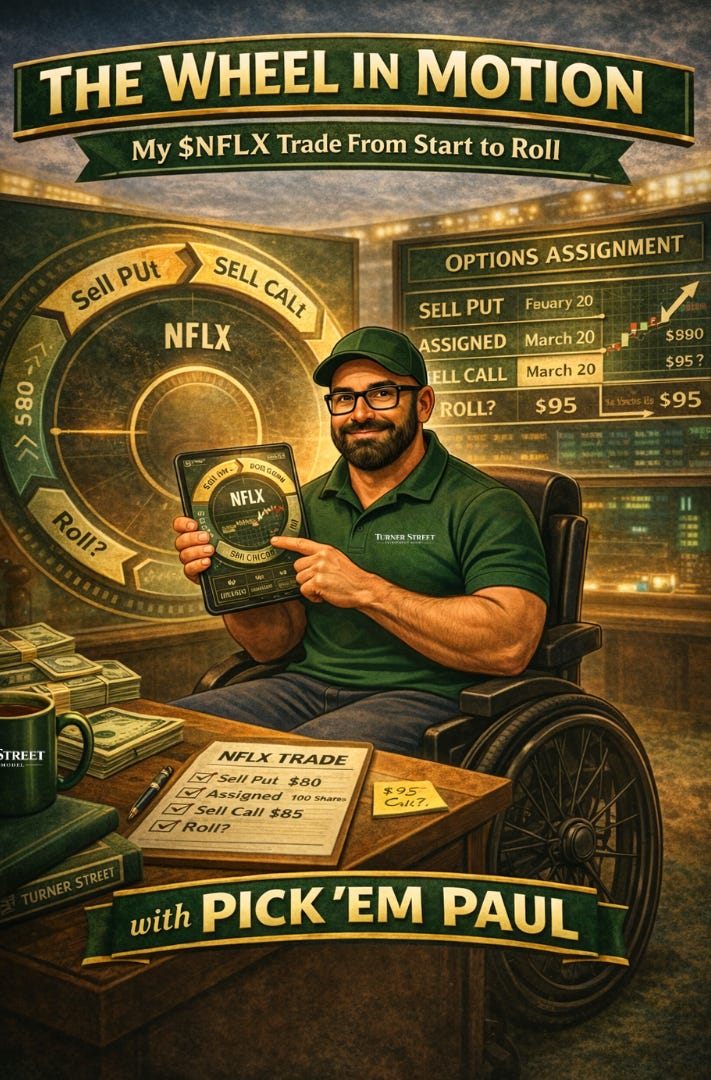
The Options 101 post explains the theory of the Wheel Strategy. But at some point, the best way to learn this stuff is to just watch a real trade happen in real time.
So here it is.
This is my most recent wheel trade on $NFLX, start to finish. The entry. The assignment. The covered call. The twist nobody saw coming. The real-time gut punch. And the roll I agonized over before finally making.
No part of this is theoretical. Every number is real. Including the uncomfortable ones.
How Netflix Got on My Radar
For most of my options life, Netflix was not a stock I could realistically trade. At over $1,100 per share before the split, selling a single cash-secured put meant having more than $110,000 sitting in your account ready to cover assignment. That is not a Pick ‘em Paul position size. That is someone else’s problem.
Then on November 17th, 2025, Netflix did a 10-for-1 stock split, bringing the share price from north of $1,100 down to around $110. One of the best businesses in media suddenly became a stock I could realistically work with.
I watched it closely after the split and the stock started drifting lower. That caught my attention. Not because something was wrong with Netflix, but because I believe Netflix is a long-term winner in the media space. Streaming is the ballgame. Netflix is still leading it. A pullback in a name I believe in is exactly the kind of setup I look for when selling puts.
So I started watching the options chain.
The Cash-Secured Put: Getting Paid to Wait
My process for selling cash-secured puts has one core rule before anything else: I only sell puts on stocks I would genuinely be okay owning. Not stocks I think might go up. Stocks I would be comfortable holding for six to twelve months if the trade went against me.
Netflix cleared that bar easily.
I sold the $80 cash-secured put for $1.76 in premium, expiring on February 20th, 2026.
Here is why that specific strike made sense.
My target when selling a 30-day put is to collect somewhere between 1.5% and 2% of the strike price in premium. That is the range I have landed on as my comfort zone. Enough to make the trade worth doing. Not so much that I am reaching for premium and taking on more risk than I realize.
$1.76 divided by an $80 strike price comes out to 2.2%. That clears my target. The trade made sense on paper, so I placed it.
With that put sold, I had $8,000 set aside to cover assignment. That cash sits there and does nothing exciting while you wait. But collecting $176 to be patient on a stock you already believe in is not a bad way to spend a month.
Pick ‘em Paul Rule: If you are selling a cash-secured put after a big green run, you are probably late. I look to sell puts after red days or during small pullbacks, when fear picks up and premiums are a little richer.
February 20th: Assignment
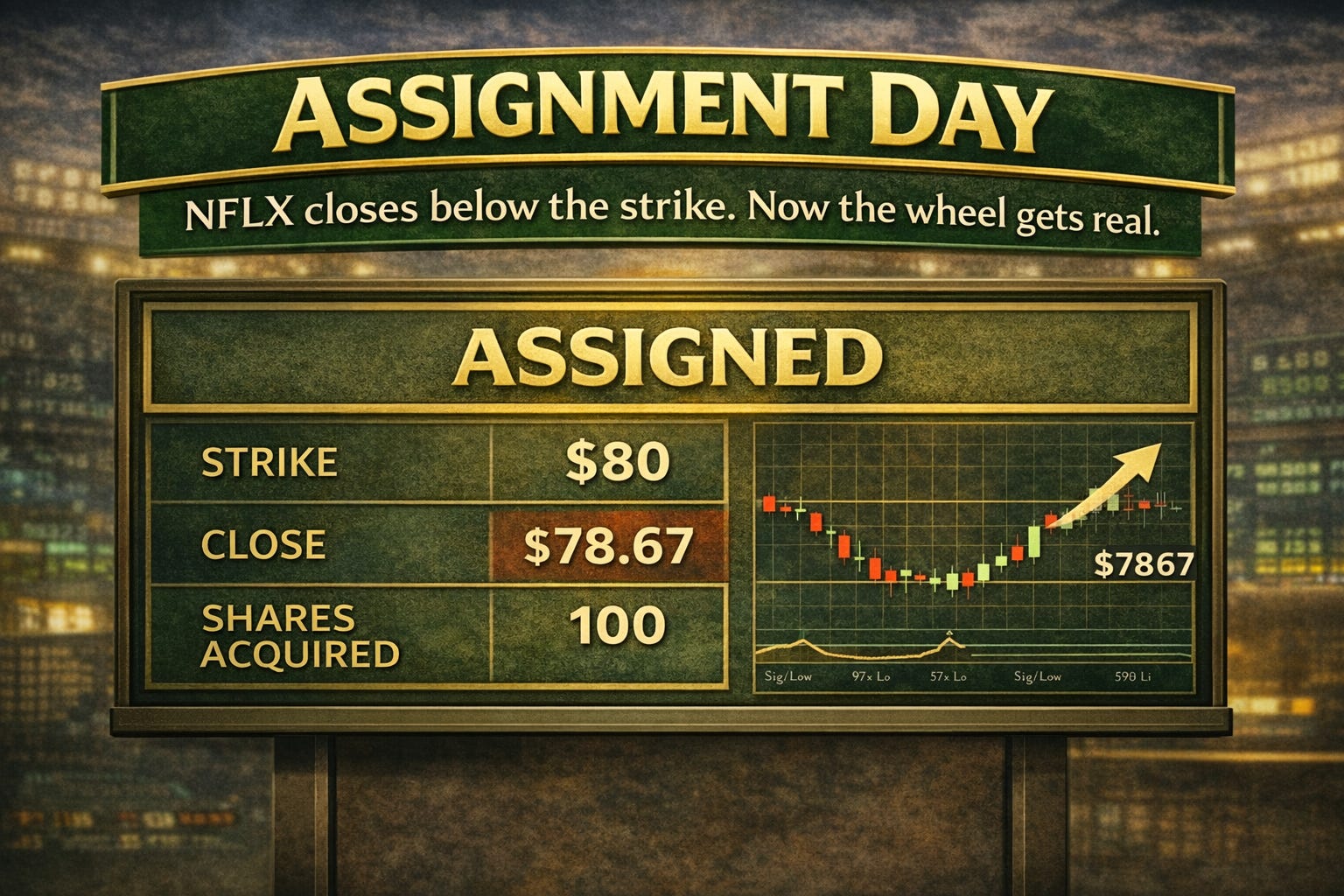
Netflix closed at $78.67 on February 20th.
That put me below my $80 strike, which meant I was assigned. I now owned 100 shares of Netflix at $80 per share, even though the market said they were worth $78.67.
Here is the thing about assignment: it is not a disaster. Assignment is the plan. When I sold that $80 put, I was saying out loud that I was willing to buy Netflix at $80. The stock went below $80. I bought at $80. That is exactly what I signed up for.
My effective buy price after accounting for the premium I collected? $78.24 per share. Not $80. The $1.76 I collected when I sold the put chips away at the cost basis from day one.
Now I owned 100 shares and it was time to move to the second half of the wheel.
The Covered Call: Getting Paid to Wait Again
That following Wednesday, February 25th, Netflix had a solid green day. So I sold the $85 covered call for $2.16 in premium, expiring on March 20th, 2026.
Green days are when I prefer to sell covered calls. When the stock is up, premiums are often a little richer and you are selling at a better price than you would be on a flat or down day. It is the mirror image of selling puts on red days.
The math on this trade looked clean:
• $2.16 divided by my $80 cost basis comes out to 2.7% premium in less than 30 days. Above my target.
• If the stock stayed below $85 by March 20th, I would keep the premium and keep my shares.
• If the stock climbed above $85 and got called away, I would sell at $85, keep the $2.16 premium, and also pocket $500 in stock appreciation from my $80 purchase price.
Over $200 in premium in under 30 days, plus $500 in built-in gains if the stock cooperated. Both outcomes were outcomes I was okay with. That is the whole point of the checklist.
I felt good about this trade. That feeling did not last long.
Pick ‘em Paul Rule: If you are not okay with either outcome of a covered call, the strike is wrong. The trade should feel like a choice you made, not a gamble you are hoping works out.
February 26th: The Twist
I did not see the news first.
I was going about my day when I noticed Netflix had popped. Not a little pop. A real one. I pulled up the chart and the stock was moving hard and I had no idea why. So I did what anyone does: I looked it up.
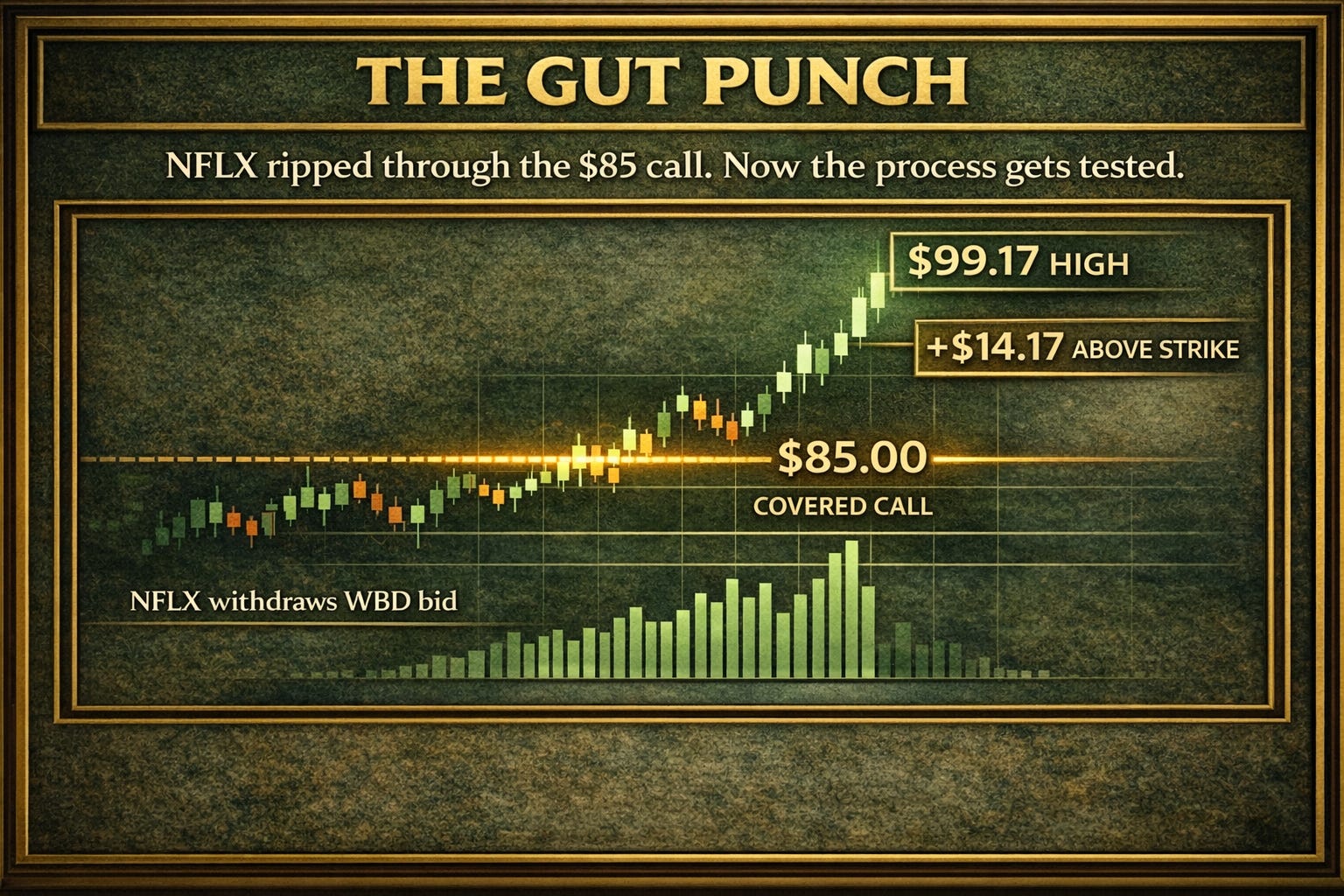
Netflix had withdrawn its bid to acquire Warner Bros. Discovery. The market loved it. The stock ran, closing as high as $99.17 on March 5th.
And I was sitting there with a $85 covered call I had sold the day before.
My first thought, and I am going to quote myself accurately here: “I can’t believe I sold a call at the exact worst time one could sell a call on $NFLX.”
That is the kind of sentence you say to yourself when you watch a stock you own run from the mid-80s to nearly $100 and your upside is capped at $85. The premium that felt great 24 hours earlier suddenly felt like a consolation prize.
The rough math on what I missed: approximately $1,000 in additional upside above my strike. That is the cost of selling a covered call on a name that suddenly has a major catalyst nobody saw coming.
Here is the thing I had to remind myself: I did not do anything wrong. I ran my checklist. I checked for known upcoming events. The WBD situation was out there as background noise but nobody had the withdrawal date circled on a calendar. This was not a case of ignoring a red flag. This was a news event that happened the day after I placed a trade.
That does not make it sting less. But it matters for how you process it and what you do next.
Pick ‘em Paul Rule: Always check for earnings dates and known catalysts before selling a covered call. I did that here and still got caught by surprise. Sometimes the market just does that. What you cannot do is let one bad surprise talk you into abandoning a process that was sound.
The Roll: My Most Agonized Decision of This Trade
With 15 days still left before my March 20th expiration, I watched the stock cool off from its peak. By the time March 20th arrived, Netflix had pulled back to around $91. The market was having a rough day overall.
I had a decision to make. I could let my shares get called away at $85, collect the premium, and move on. Or I could roll the position and stay in the trade.
I want to be honest about this part: I went back and forth. This was not an obvious call.
The case for letting the shares go was real. I had already made money on this trade. The premium from the put, the premium from the call, and $500 in stock appreciation added up to a clean profitable outcome. Walking away at $85 on stock I bought for $80 is not a bad result. There is nothing embarrassing about that exit.
The case for rolling was also real. I still believe in Netflix long term. My TSIM model, the multi-factor evaluation framework I use to score stocks, puts a 12-month target price of $98.13 on the stock. With the shares currently trading around $92.42 as I write this, that still implies meaningful upside. Selling at $85 and walking away from a stock my model says is worth nearly $100 just did not sit right.
So I rolled. And yes, I am aware of the irony that the guy in the wheelchair is out here talking about rolling. Nobody calls me the rolling quad yet, but I am working on it.
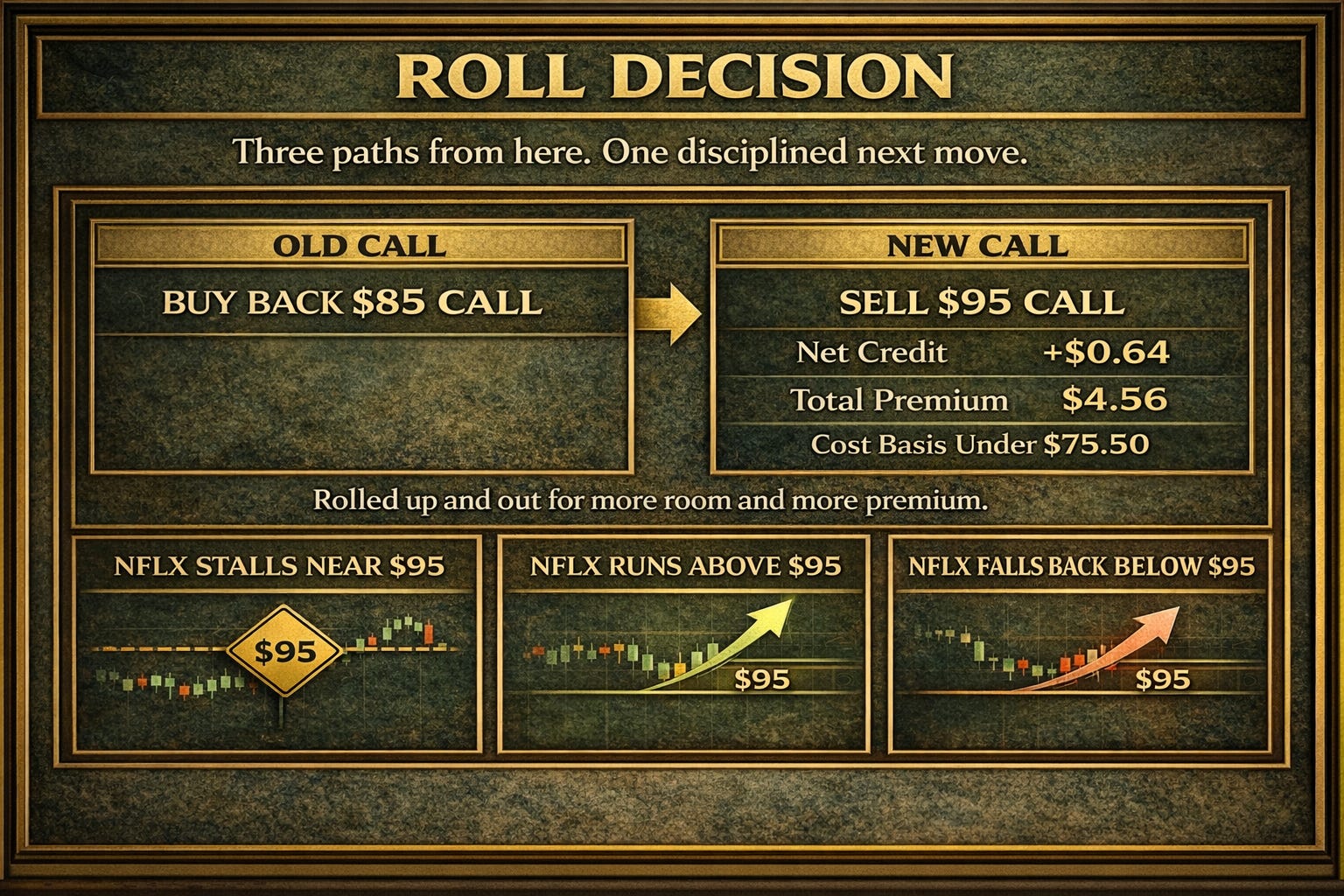
I bought back my $85 covered call for $6.25 and sold the $95 covered call expiring July 17th, 2026 for $6.89. That is a net credit of $0.64 to extend the trade.
When I roll, I want to receive a credit whenever possible. Taking in money to extend the trade beats paying out of pocket to buy yourself more time. $0.64 is not exciting. But it is not nothing either, and it keeps the premium income flowing in the right direction.
The Full Premium Math
Here is everything this wheel has generated so far on this one position:
• $1.76 from the original cash-secured put
• $2.16 from the first covered call
• $0.64 net credit from the roll
Total premium collected: $4.56 per share, or $456 on 100 shares.
My effective cost basis on Netflix is now less than $75.50 per share instead of the $80 I paid at assignment. That is a meaningful reduction, and it gives me more cushion if the stock keeps sliding before July.
The Honest Drawbacks of Rolling
Rolling is not a magic fix. It comes with real tradeoffs and I knew all of them when I made the decision.
• The July 17th expiration goes through the next earnings cycle. Earnings can gap a stock hard in either direction and I am now exposed to that.
• I cannot sell additional covered calls on Netflix for the next four months. That is four months of potential premium sitting untouched.
• I extended a trade I was hoping to close. Every week this stays open is a week my capital is committed here instead of somewhere else.
I am eyes open on all of that. The roll was the right call for my situation and my thesis on the stock. But I am not going to dress it up as a clean win. It is a decision made under uncertainty, like every decision in this game.
Where Things Stand and What Happens Next
As of right now, Netflix is trading at $92.42. I own 100 shares with a cost basis under $75.50, a $95 covered call outstanding through July 17th, and a TSIM target price of $98.13.
Here is how I am thinking about the three main paths from here.
Path 1: Netflix Hovers Around $95 on July 17th
This is the ideal scenario. The stock trades near my strike, the call expires or my shares get called away right around $95, and I walk away with the premium and the appreciation. Clean exit. Start the wheel over somewhere else.
Path 2: Netflix Runs Well Above $95 Again
Same situation as the WBD news, but I have more room this time. If the stock is well above $95 heading into July and I can roll for a credit to a higher strike or a later date, I will look at it seriously. If I cannot get a credit and the stock has genuinely broken out, it might be time to let the shares go, book the gains, and move on. Getting called away at $95 on stock I bought for $80 with $4.56 in premium on top is still a very good trade.
Path 3: Netflix Falls Back Below $95
If the stock is below $95 by July 17th, my call expires worthless and I keep the premium. My job then is to sell a new covered call at a strike above my cost basis whenever a reasonable setup shows up. Anything above $80 with acceptable premium works.
If Netflix fundamentally broke and I needed to exit the position entirely, I could sell a covered call at the $75 strike and get out at approximately breakeven. I think that is the least likely of the three scenarios. But it is the scenario you always plan for before you need it.
The Pick ‘em Paul Bottom Line
The wheel is not a guarantee. It is a process.
I entered Netflix because I believed in it. I collected premium while waiting to buy. I got assigned and started collecting premium while holding. I got surprised by a news event and watched the stock run past my strike. I sat with a decision for a while, genuinely went back and forth, and then rolled instead of letting go because I still believe in the stock.
None of that is a mistake. Every part of it was a decision made with a reason attached to it. Including the parts that stung.
The premium I have collected has already lowered my effective cost basis by more than four dollars per share. The model gives me a target that still implies real upside from where we sit today. And I have a clear plan for each of the three directions this trade can go from here.
That is what the wheel actually looks like in practice. Not a clean chart where everything goes right. A real trade with a real gut punch in the middle and a real decision to agonize over when things got complicated.
This is JPM Picks. We show the work, including the parts that make you say things to yourself you would not repeat in polite company.
Pick ‘em Paul Rule: The wheel works best when assignment feels like the plan and rolling feels like a choice. If either one of those feels like a disaster, check your strike discipline before you check anything else.
This is JPM Picks. Just Paper Money, for entertainment and educational purposes only. Not financial advice. Not gambling advice. The Turner Street Investment Model is an educational framework. Scores reflect relative rankings, not guarantees of future prices. Always do your own homework and never risk money you cannot afford to lose.