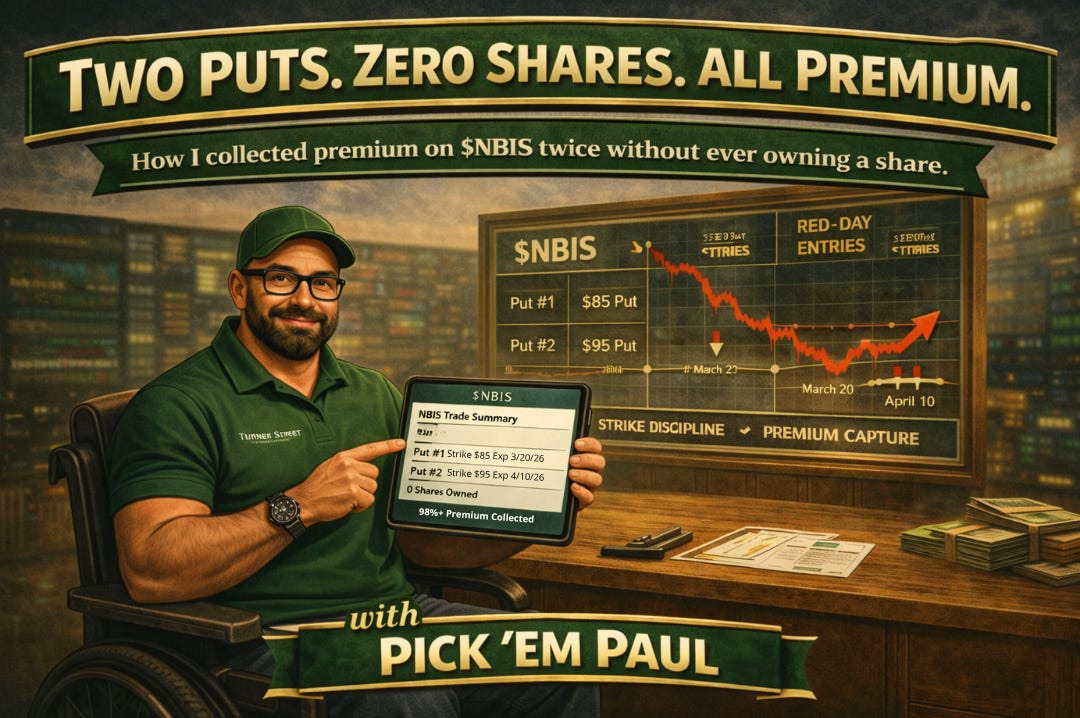
I want to tell you about a trade I made on a stock my own model told me to avoid.
That part matters, and I will get to it. But first, let me tell you what happened, because the result was one of the cleaner premium collection sequences I have run in a while. Two cash-secured puts. Two red-day entries. A combined premium just shy of 100% kept across both trades. (Closing early to reclaim capital does not mean leaving money on the table when you have already captured 98% of what was there.) And at no point did I own a single share of $NBIS.
That is the whole game I am going to walk you through today.
First, What Is $NBIS?
Nebius Group trades on the Nasdaq under the ticker $NBIS. If the name does not ring a bell, here is the short version: Nebius is a full-stack AI infrastructure company. They build and operate large-scale GPU clusters, cloud platforms, and developer tools designed specifically for AI workloads.
Think of them as picks and shovels for the AI boom. While the rest of the market debates which AI model wins, Nebius is building the infrastructure that all of them need. They are headquartered in Amsterdam and listed in New York, which makes them an interesting hybrid of European tech sensibility and American growth stock energy.
They also own a handful of other businesses you may not have heard of: Avride, which works on autonomous driving technology; Toloka, a data partner for AI development; and TripleTen, an edtech platform focused on reskilling people for tech careers.
The company was formerly known as Yandex before restructuring its ownership post-Russia sanctions. The new Nebius is a different animal than the old Yandex, but that backstory is part of why some investors have been slow to pay attention.
The reason the stock has been moving the way it has? A few things hit at once. Nebius signed a $27 billion deal with Meta to deploy computing capacity. They are reportedly pursuing an acquisition of AI21 Labs. And they are set to launch a 310 megawatt data center facility in Finland, which would be the largest in Europe. That is a lot of positive momentum stacking up in a short window.
The market has been repricing accordingly, and the 33% surge in shares following that wave of analyst coverage tells you how quickly sentiment can shift when a story starts to crystallize.
What My Model Said (And Why I Still Traded It)
Here is where I owe you some transparency.
I ran $NBIS through the Turner Street Investment Model after making these trades, and the TSIM came back with an avoid/sell rating. The primary reason is the P/E ratio. Yahoo Finance has it sitting at over 1,200. That is not a typo. When you plug a number like that into a model that weights fundamental valuation heavily, the score craters.
My TSIM target price on $NBIS is $102.50.
Here is where it gets interesting: both strike prices I used were below that target. The $85 strike and the $95 strike both sat underneath what my own model considers fair value, so I was not actually violating the core rule of cash-secured puts, which is that you only sell them at prices you would be genuinely comfortable owning the stock. My strikes were below my target. The model’s overall rating was negative, but the specific trades were still consistent with my framework.
I will be honest: I also just disagree with my own model on this one. That does not mean the model is broken. It means the P/E on a high-growth infrastructure company in the middle of signing billion-dollar contracts with Meta and pursuing an AI21 Labs acquisition is not the same kind of signal it would be on a mature business. A four-digit P/E on Nebius right now is a different data point than a four-digit P/E on a company with no growth runway.
For context: Wall Street analyst targets on $NBIS currently range from $129 to $215. The street is considerably more bullish than my $102.50 model price. That gap is worth naming, not defending. The model is telling me one thing, professional analysts with full research teams are telling me something else. I am not dismissing either view. I am just being transparent about where they diverge.
I am still trying to become a more disciplined trader. I am still developing the process. Part of that process is knowing when the model is capturing something real and when it is getting distorted by a single outlier input. The weights in the TSIM will continue to evolve as I gather more data.
Trade One: Selling Into the Red
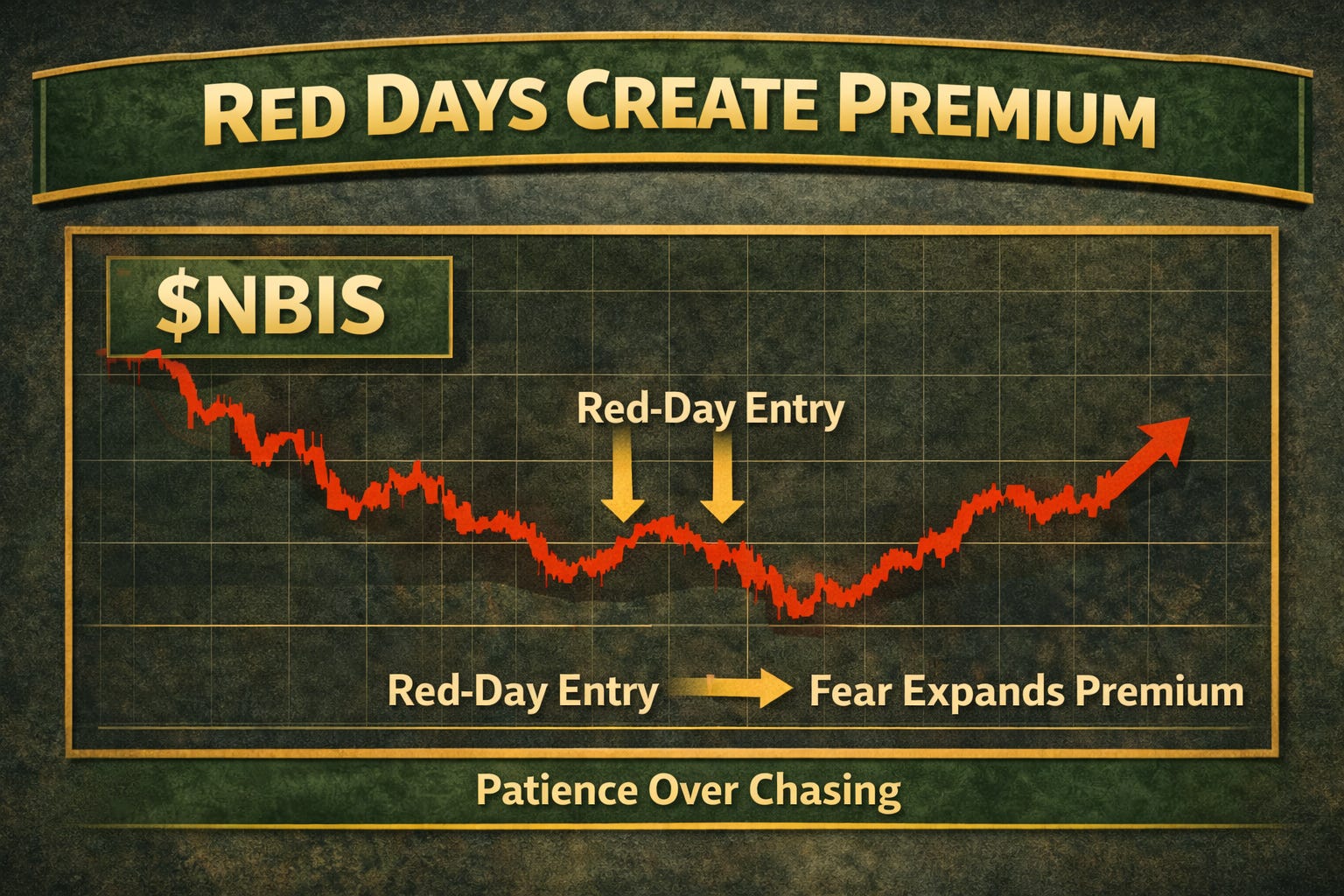
March 5th, $NBIS closed at $95.65. The next morning it opened at $92.30. That is a meaningful overnight gap lower, and when a stock opens red like that on no news that changes the underlying thesis, the options market tends to overprice fear. Implied volatility picks up. Premiums get richer.
That is the spot I look for. Not random days. Red days on stocks I have already been watching.
On March 6th, I sold a cash-secured put at the $85 strike with an expiration date of March 20th. The stock was trading around $92 at the time, so I was about $7 out of the money. I collected a premium that represented a strong return on the capital set aside to back the trade, and I collected it that same day.
The stock never threatened $85. On March 20th, the put expired worthless. I kept every dollar of that premium.
That is the trade. No drama. No assignment. Just premium collected and capital returned.
Trade Two: Going Up the Chain
After the first put expired, $NBIS had moved. By March 25th the stock had closed at $115.09. The thesis was still intact, the stock was stronger, and I wanted to run the same play again.
The next morning, March 26th, $NBIS opened red again. At one point during the session it dipped as low as $105.41. Another fear-driven dip on a stock I had already been watching. Same setup, different level.
I sold a $95 put expiring April 10th and collected a solid premium in exchange. I moved up $10 from my first strike to reflect where the stock had traded. Both strikes remained below my TSIM target of $102.50, so I was still inside my own framework.
Then the stock ran.
By April 8th, $NBIS had gotten as high as $127.75. The $95 put I sold was nowhere near being threatened. At that point, I had already captured more than 98% of the original premium. The option had almost no value left.
On April 8th, I bought to close for $3.
Why Close Early When You Have 98% of the Premium?
This is a question worth slowing down on because it trips up a lot of beginners.
The remaining 2% of premium you leave on the table is not meaningful. The capital you free up absolutely is. Weird things happen in the stock market, a headline drops, a sector rotates. A stock that was sitting comfortably above your strike suddenly has a bad two-day stretch. Closing a position when you have captured nearly all of the available premium removes that risk entirely and gives you your capital back to work with.
In this case, I also had a specific reason: I wanted to look for a third put opportunity before the expiration date. I thought a pullback might come that would set up another red-day entry.
It did not.
The Third Put That Never Happened
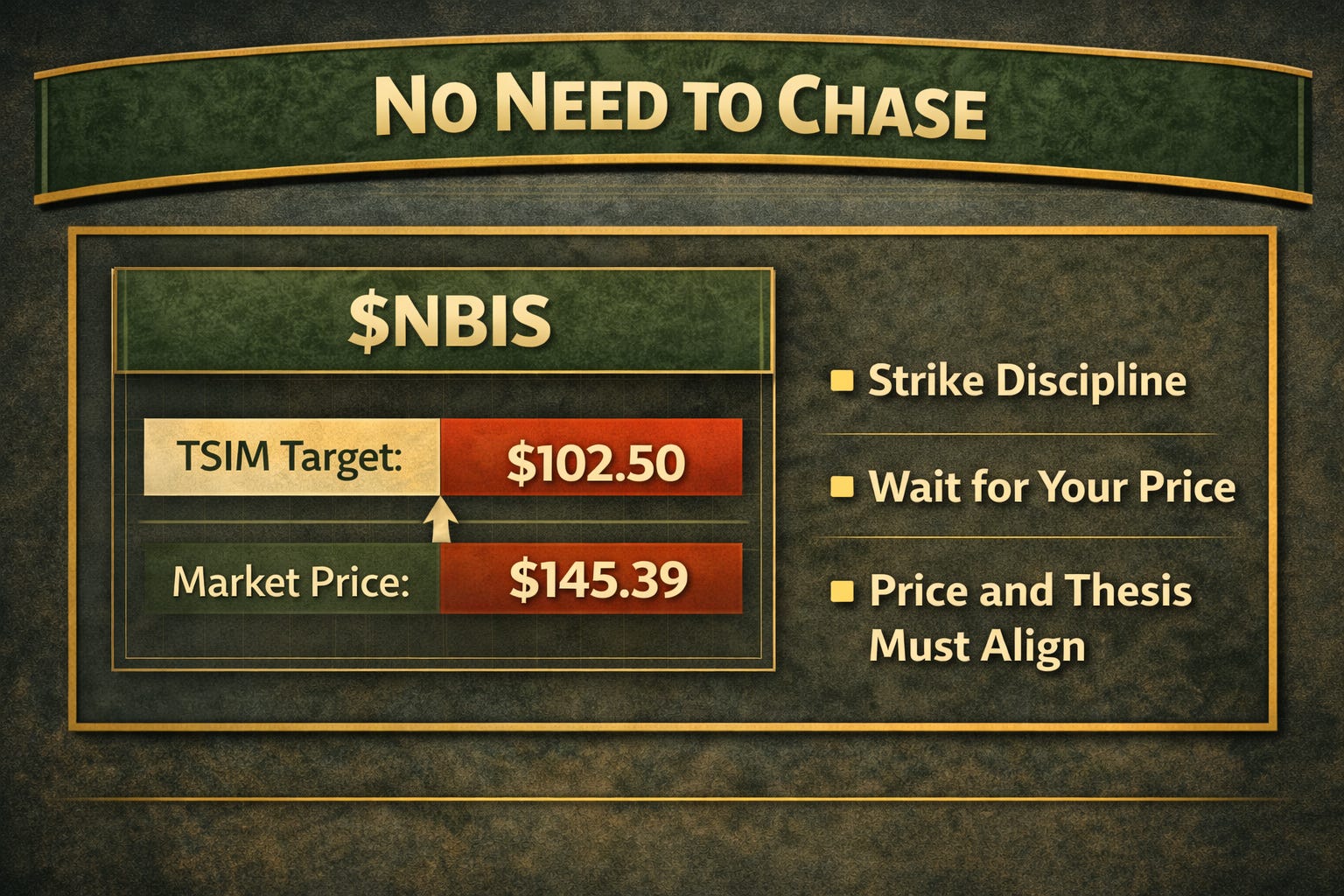
As of this writing, $NBIS is trading at $145.39.
The pullback I was waiting for never came. The stock just kept going. I did not find another entry I was comfortable with before the expiration date, so no third trade was made.
I probably should have scanned more actively before I closed the second put. Every dollar matters in this game, and having my capital tied up waiting for a setup that never arrived was a small opportunity cost. That is a real lesson. If you are closing a position early to hunt the next play, make sure you have already done the homework on what that play might be.
I am also not going to sell a put on a $145 stock when my TSIM target is $102.50. That would break the actual rule. You do not sell cash-secured puts at strike prices you would not genuinely be comfortable owning the shares at. If $NBIS pulled back hard toward my target and the premium was there, that would be a different conversation. At $145, with a model pointing to $102.50 fair value, I am watching from the sideline.
The Result
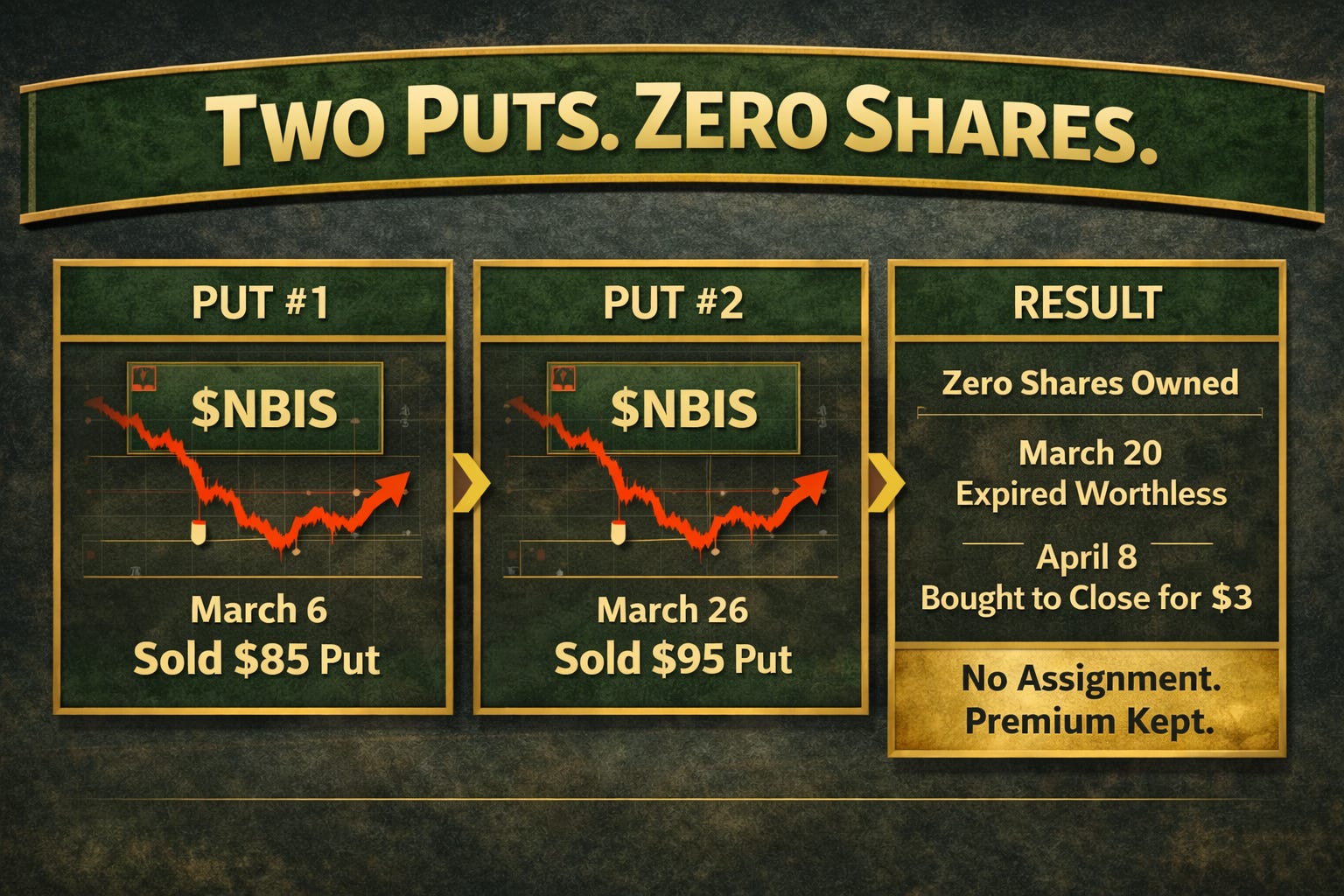
Two cash-secured puts on the same stock, both entered on red days, both exited with the premium largely intact. Combined, the two trades generated a premium return well above what most people would expect from a cash position sitting idle over that same period. And at no point did I own a single share.
The key inputs that made both trades work:
Red-day entries: both puts were sold into fear-driven dips, which meant richer premiums and more cushion between the stock price and the strike.
Strike discipline: both strikes sat below my TSIM target price of $102.50, which meant I was only agreeing to buy at prices I considered reasonable given my own analysis.
Knowing when to close: capturing 98% and moving on is almost always the right call. The last 2% is not worth the tail risk.
Staying honest about the model: the TSIM rated this a sell, and I traded it anyway. But the trades were still inside my rules. The model is a tool, not a command. I am building a process, not following one blindly.
The Pick ‘em Paul Bottom Line
Cash-secured puts are not about owning stock. They are about getting paid to be willing to own stock at a price you have already decided is reasonable.
The red-day entry is the edge. The strike discipline is the protection. The early close at 98% captured is the discipline that keeps you from getting complacent.
$NBIS is now at $145 and climbing and my model target price says $102.50. I am not chasing it. The next time I look at this stock as a trade candidate is when the price and my thesis are back in the same zip code.
Until then, the premium is collected, the capital is free, and the process did its job.
Pick ‘em Paul Rule: Red days create premium. Patience creates opportunity. Strike discipline keeps you honest. And knowing when to walk away is a skill, not a failure.
Are you using red-day dips as put entry signals on stocks you already have a thesis on? Hit reply and tell me what you’re watching.
This is JPM Picks. Just Paper Money, for entertainment and educational purposes only. Not financial advice. Not gambling advice. The Turner Street Investment Model is an educational framework. Scores reflect relative rankings, not guarantees of future prices. Always do your own homework and never risk money you cannot afford to lose.